
Pressure Gauge Supplier Malaysia

Industrial Pressure Measurement Guide
Choosing a pressure gauge is not only about matching the pressure range. The correct gauge must also suit the process media, operating temperature, vibration, connection, accuracy and safety requirements of the application.
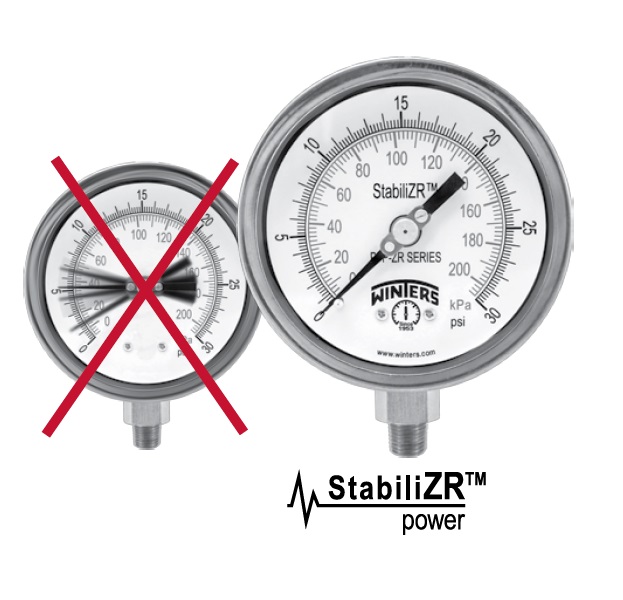
WINTERS PFP StabiliZR fully stainless steel pressure gauge. Final configuration depends on the application.
For engineers, maintenance teams and purchasing departments looking for a pressure gauge supplier in Malaysia, the most important question is not simply “Which model is available?” It is “Which instrument will provide a reliable and safe reading under the actual process conditions?”
TRINITY INDUSTRIAL SOLUTION SDN BHD supplies industrial pressure instruments and supports customers with practical product selection for manufacturing, water treatment, HVAC, food and beverage, pharmaceutical, chemical and general process applications across Malaysia.
What Does an Industrial Pressure Gauge Do?
A pressure gauge provides a local visual indication of the pressure inside a pipe, vessel, machine or process system. Depending on the gauge design, it may measure positive pressure, vacuum, compound pressure or very low differential pressure.
Pressure gauges are commonly used for operator checks, commissioning, troubleshooting and routine maintenance. Where a continuous signal is required for a PLC, recorder or control system, a pressure transmitter or pressure switch may be used together with, or instead of, a local gauge.
8 Factors to Check Before Choosing a Pressure Gauge
Which Pressure Gauge Type Is Suitable?
| Gauge Type | Typical Use | Important Selection Note |
|---|---|---|
| General-purpose gauge | Air, water, pumps and general machinery | Confirm range, thread and media compatibility. |
| Stainless-steel process gauge | Chemical, oil and gas, aggressive environments | Check case and wetted-part material separately. |
| Liquid-filled gauge | Vibration, pulsation, pumps and compressors | Filling reduces pointer flutter but does not replace proper system protection. |
| Capsule / low-pressure gauge | Low-pressure gas and vacuum applications | Use only with compatible clean gaseous media unless specified otherwise. |
| Sanitary pressure gauge | Food, beverage, pharmaceutical and hygienic processing | Confirm tri-clamp size, surface finish, cleaning method and approval requirements. |
Pressure Gauge Options Available from Trinity
Trinity supplies a range of WINTERS and other industrial pressure instruments. The most suitable model depends on the operating conditions and required performance.
- Process pressure gauges: suitable for demanding industrial, chemical and petroleum applications where robust construction and operator safety are important.
- Stainless-steel gauges: for corrosive environments and applications requiring stainless-steel wetted parts.
- Capsule pressure gauges: designed for low-pressure gaseous media and vacuum measurement.
- Sanitary pressure gauges: configured for hygienic process connections in food, beverage and pharmaceutical equipment.
- Diaphragm seals and accessories: used when the gauge requires isolation from corrosive, viscous, hot or clogging process media.
Common Pressure Gauge Selection Mistakes
- Choosing only by price: an unsuitable material or range can create maintenance costs that exceed the initial saving.
- Using a range that is too high: the gauge may survive the pressure but provide poor reading resolution during normal operation.
- Ignoring pressure spikes: water hammer, pump start-up and valve operation can expose the gauge to brief overpressure.
- Confusing BSP and NPT threads: forcing incompatible connections can damage threads and compromise sealing.
- Installing directly on hot service: steam and high-temperature media may require protective accessories and a suitable installation method.
Information to Prepare for a Quotation
To receive a more accurate recommendation, provide as much of the following information as possible:
- Measured media
- Normal and maximum pressure
- Operating temperature
- Required connection and thread
- Dial size and mounting orientation
- Wetted-part material
- Accuracy or applicable approval
- Photo or nameplate of the existing gauge, where available
Frequently Asked Questions
What pressure gauge range should I choose?
The range should cover normal operation and expected fluctuations while keeping normal readings easy to see. Share the normal pressure, maximum pressure and any known surge conditions with the supplier.
Do I need a liquid-filled pressure gauge?
Liquid filling is often useful where vibration or pulsation causes an unstable pointer. The complete installation should still be evaluated for pressure spikes and temperature.
Can a standard gauge be used for chemicals?
Only when every wetted component is compatible with the chemical and process conditions. A suitable stainless-steel gauge, special alloy or diaphragm seal may be required.
Does Trinity supply pressure gauges throughout Malaysia?
Trinity is based in Puchong, Selangor and supports industrial customers across Malaysia. Product availability and delivery timing depend on the selected model and specification.
Need Technical Selection Support?
Talk to Trinity Industrial Solution
Send us your pressure range, media, temperature and connection details for a suitable pressure gauge recommendation and quotation.
WhatsApp +6012-601 2034 Request a QuotationScope: General industrial pressure gauge selection guidance. Final suitability should be confirmed against the application conditions and manufacturer documentation.
Last reviewed: 17 August 2026
Aug 17,2026